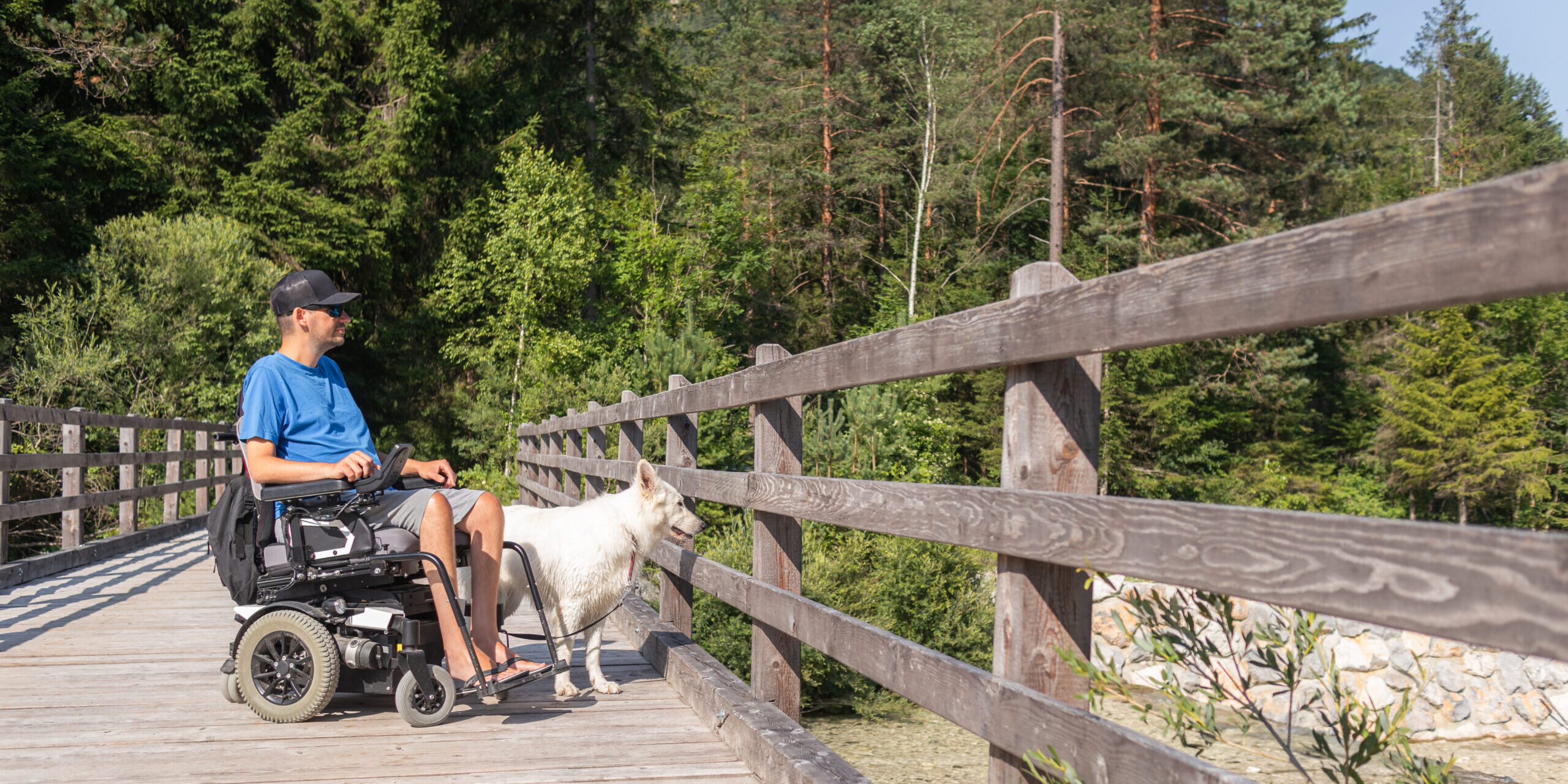
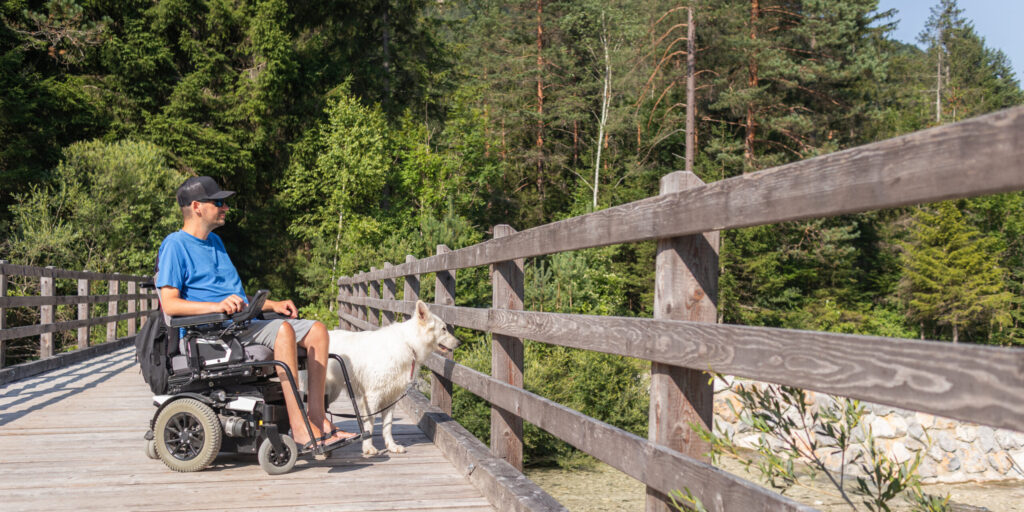





Third-grader Wesley McHugh couldn’t wait to see the new playground at his school in Mandeville, La., near New Orleans. His excitement quickly changed to disappointment when his electric wheelchair was unable to maneuver over the bark-covered surface. During recess, he sat on the sidelines and watched his classmates play.
Wesley, who has nemaline myopathy, graciously accepted another barrier in his young life.
Wesley’s mother, Susan McHugh, was more vocal in her disappointment with the new playground, built in 2004. She spent hours commiserating with the frustrated mothers of other special needs children in her community
Fix it, Mom
Overhearing his mother’s conversations, Wesley told her, “Mom, I know that you’re upset, but don’t worry about me. It’s OK if I don’t get to play, but you have to fix it for all the other kids who want to play.”
McHugh didn’t know how to “fix it.” She sought the advice of her friend Michelle Pecoraro. Each woman has three children, and they’ve been friends since their oldest children were in preschool. Pecoraro’s third child, Angelle, has Orbeli’s syndrome, which causes a range of disabilities.
Pecoraro remembered reading a Woman’s Day article about accessible playgrounds. The article described how Amy Jaffe Barzach’s 9-month-old son Jonathan had died from spinal muscular atrophy. Wanting to honor her son’s life, Barzach mobilized 1,200 volunteers and built a state-of-the-art playground for children of all abilities in West Hartford, Conn., in 1996.
They called it Jonathan’s Dream. (See “Child’s Play,” April 1999)
Barzach is the co-founder and co-director of the National Center for Boundless Playgrounds, a nonprofit organization that assists communities with the creation of barrier-free playgrounds.
“When children of all abilities grow up playing together, they learn to accept their differences and celebrate their similarities, which ultimately leads to a world where everyone can contribute. I am so delighted that something that started out as just a dream is making such a difference in so many children’s lives,” Barzach said.
In a Boundless Playground, at least 70 percent of the play activities can be enjoyed by children with physical challenges without having to leave their support equipment (such as wheelchairs or braces) behind. Children in wheelchairs play in raised sandboxes, ramps go to the highest play decks, and swings have high support backs with armrests.
There are more than 70 Boundless Playgrounds in 20 states and Canada, with dozens more in development across the country. Barzach explained that, with each new playground, more people realize what’s possible and want to duplicate it in their own communities.
![]() |
| Susan and Wesley McHugh |
Going boundless
McHugh and Pecoraro agreed they should change their focus from the playground at Wesley’s school and direct their efforts to building a new one where their children could play at any time and with anyone.
They called Boundless Playgrounds for advice on how to begin. Together, with seven more women, they formed an executive board and named their group Kids Konnection. Their mission was to create a playground where kids of all abilities could connect through play.
“I’ll always remember the night we met and decided on our name,” McHugh, president of Kids Konnection, said. “Our dream was to help children build relationships and connect through play. I never thought about the wonderful relationships that we [parents] would build as we worked together to attain this amazing goal.”
Community effort
As the word was spread through the community, people embraced the project. Pecoraro told her next-door neighbor that she was going to build an accessible playground with her friends. His company, iBusiness.com, gave her a $5,000 donation and valuable marketing support, including the design of a Web site and creation of a Kids Konnection video.
McHugh got the support of the president of her parish (county) and, with his help, found a location for the playground. It’s in Mandeville, in St. Tammany Parish, the fastest-growing county in the state where approximately 7 percent of the children have disabilities.
Nearly an acre of land has been provided in the Tammany Trace, a 31-mile recreational corridor for pedestrians, bicyclists, equestrians, rollerbladers and joggers that’s governed by the parish. In addition, Kids Konnection was made a Tammany Trace Foundation committee, enabling it to immediately become a tax-exempt, nonprofit organization.
The next major step was to find the money.
Kids Konnection held four major fundraising events: a kickoff party, a kids’ day, an art auction, and an evening gala that featured a silent auction, food from 50 local restaurants and entertainment. The first event generated $5,000 in donations, while the fourth made $250,000.
In a little over a year, the group raised almost its entire $400,000 goal.
With each fundraiser, the community’s awareness of Kids Konnection increased. From schoolchildren collecting pennies to the support of the local Kiwanis, everyone wanted to help.
Dream come true
“We’re not just building swings and slides. We’re changing the way children and adults react with one another. Accepting each other for who they are, not what they can do,” said McHugh, who has worked for more than two years to “fix it” for the children.
In summer 2005, the team began working with a civil engineer to develop a schematic and draw up plans for site work. But then came Hurricane Katrina. The storm’s massive destruction to St. Tammany Parish stalled the project for several months, but this spring, the group got back on track.
The St. Tammany Kids Konnection Boundless Playground is scheduled to open by the end of the year.
“I’m pretty happy that my Mom is doing this and I am happy that all the other kids who have special needs will be able to play, too. I’ve never been able to play on a playground before with my friends or my brothers, and now I can! I am looking forward to playing in the water and the sand! And, I think the ramps that take me up high will be fun,” said Wesley.
The new playground will allow kids with disabilities to play with their friends and siblings, and will enable parents with disabilities to keep a closer eye on their children at play. Accessible paths wind through the area. There will be swings for tots, a tire swing and one designed for wheelchair users.
Kids can crawl through tunnels, climb a wall or get the tunnel experience in a vine-covered arbor. A maze and a sensory garden will feature sound-play instruments, chalk painting and places to stop to smell the flowers.
The sand-play area will have tables at varying heights so children of all abilities can play side by side. Imaginations will soar as kids act out their favorite stories on the performance stage.
Born of passion
“As parents of a special-needs child, we can’t sit back and expect someone to do what we need done for our children,” McHugh has learned. “We have to be our children’s advocate. You can’t just assume that your school, or your city or state government is going to do what you need done.
“It goes beyond that — it has to come from our passion for doing what is best for our children.
“Don’t sit back and wait for someone else to do it.”
Also see "Kids @ Play: Kids of Different Abilities," from this issue.
|
Planning an accessible playground and exploring key questions about its use can make all the difference in whether the end product is successful. “Some of the most heartbreaking calls that we get are from people who have just built a playground that was supposed to be ‘accessible,’” Amy Barzach, co-director of the National Center for Boundless Playgrounds, said. “When the children with disabilities go to play there, it is a ramp to nowhere. Or, worse, a ramp to about 25 percent of the fun and the rest is teasingly out-of-reach. “Those are the calls I hate the most, because it is usually a passionate community group that had good intentions. It’s not until it’s built that they realize there is a whole lot of technical expertise that goes into knowing what components are needed and how to configure it.” Some of the key steps are: Research Visit and evaluate the existing playgrounds in your community. Take the virtual playground tour on the Boundless Playgrounds’ Web site (see “Playground Resources”). If possible, visit an accessible playground in person. Contact Boundless Playgrounds or local playground organizations to find out more about available resources and services. Identify potential supporters Supporters for accessible playground projects have included: parents, grandparents, educators, parks and recreation professionals, families of children with disabilities, elected officials, medical professionals, civic groups, foundations, organizations that serve people with disabilities, business leaders, YMCAs and YWCAs, students (elementary school through college), the media and local celebrities. Create a playground committee You’ll need a core team for planning, fund raising, promotion, volunteer recruitment and more. Once the key individuals are identified, establish their roles and responsibilities. Next, create a timeline for your project. Then, develop plans for both fund raising and communications. Before you begin raising money, it will be helpful to establish 501(c)(3) status with the Internal Revenue Service or partner with a nonprofit organization that has tax-exempt status. Explore site options When looking for potential sites, contact parks and recreation departments, school boards, parent/teacher organizations, early childhood education centers, religious organizations, and companies/organizations with a strong commitment to serving children and families. Survey the site Once you’ve identified a site, you’ll need to hire a local design professional, such as a landscape architect, to prepare an official site survey. Before committing to a site you should answer such questions as: Is the site and size appropriate for a playground? Will the site owner agree to accept the completed playground and maintain it for the life of the equipment (usually 10-20 years)? Is the site owner required to participate in a bid process? See sources listed in “Playground Resources,” for more details on what a playground should feature. Estimate a budget Budgets for accessible playgrounds vary greatly. Typically, a full Boundless Playgrounds project (for 2-to-12-year-olds) can be built for a minimum of $150,000, although budgets closer to $250,000 are more common. For a school-age playground (for 5-to-12-year-olds), the minimum budget averages $100,000. A preschool or early-intervention center playground (for 2-to-5-year-olds) can be built for a minimum of $65,000. Some playgrounds have budgets in excess of $800,000 when they cover larger sites or support areas with high population density. Partner with the pros Your committee will need to work with a team of playground industry experts, including design professionals and playground equipment representatives. Some projects hire a construction manager as well. Organizations such as Boundless Playgrounds can provide layouts, technical assistance and project coaching services. Involve the community With the help of your supporters, it’s time to build awareness of your project in the community at large and implement your communications and fund-raising plans. |
Accessible playground equipment directory
www.playgrounddirectory.com/accessible.htm
Accidental Courage, Boundless Dreams
by Amy Jaffe Barzach and Sandy Tovray Greenberg
Aurora Publishing
http://amybarzach.com/buy-the-book
Boundless Playgrounds
www.boundlessplaygrounds.org
“Guidelines for Safe, Accessible Playgrounds”
www.familyeducation.com
Guidelines of U.S. Access Board
www.access-board.gov/play
Kids Konnection
www.kidz.la
National Center on Accessibility
http://ncaonline.org
W.K. Kellogg Foundation
Able to Play (Michigan only)
www.wkkf.org